Master Internship Offer
Supervisor : Germain PHAM |
Palaiseau (France), 2026-03-12 |
Email : dpham@telecom-paris.fr |
|
Phone : +33 1 23 45 67 89 |
|
Duration : 6 months |
|
Degree : Master |
|
Fields : (Computer Science, Electrical Engineering) Machine learning, Optimization, Signal processing, Communication systems |
|
Start date : 2026-04-01 |
Introduction
Power Amplifiers (PAs) are crucial components in modern communication systems, responsible for amplifying signals to ensure effective transmission. However, PAs introduce distortion, which can degrade signal quality and system performance. Accurate modeling and simulation of PAs are essential for designing efficient and reliable communication systems.
Today, PA design and modeling are often performed using a combination of circuit-level simulations and empirical data in different software environments and time phase of the design process. This can lead to inefficiencies and inaccuracies in the modeling process and slow down the design cycle.
In addition, PA architectures are becoming increasingly complex, and traditional modeling techniques may not be sufficient to capture the nonlinear behavior of PAs accurately. Recurrent Neural Networks (RNNs) have shown promise in modeling the behavior of PAs, but there is still room for improvement.
Project description
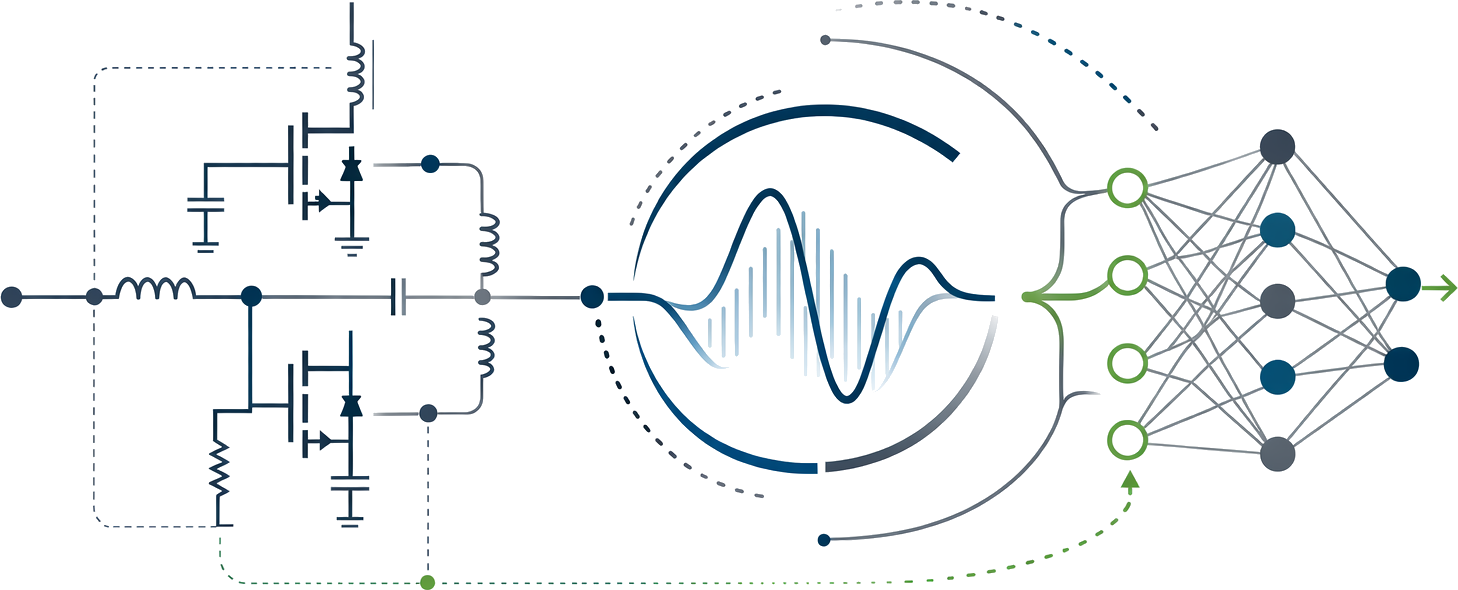
This internship project aims to explore the state-of-the-art in PA modeling and Digital Predistortion (DPD) design. The project focuses on two main tasks: - automating a co-simulation workflow that integrates Advanced Design System (ADS) and Python for PA/DPD modeling; - exploring innovative approaches in simulation-based DPD function design.
Currently, the PA design process involves several manual steps: running ADS simulations, exporting voltages from the ADS simulation bench, executing Python scripts, manually exploring DPD models, generating predistorted signals, and starting ADS simulations for validation with these signals. Automating this process will make it more efficient and reduce errors. One option is to push the project further by looking into identifying memory polynomial hyper-parameters from harmonic balance and two-tone analysis.
For the investigation of new DPD functions, the project offer different axes like the use of complex-valued neural networks and the piecewise continuity modeling to better capture the nonlinear behavior of PAs. Complex-valued neural networks can handle complex inputs and outputs, which is useful for modeling communication signals. However, training these networks is challenging due to the complexity of the operations and the need for suitable activation functions. Piecewise continuity modeling involves dividing the PA behavior into segments and modeling each segment separately, which can improve accuracy but requires careful management of transitions between segments.
Another challenge is handling unseen PAPR cases. PAPR (Peak-to-Average Power Ratio) is important in PA design because high PAPR signals can cause significant distortion. Modeling and simulating PAs for unseen PAPR cases requires robust and adaptive models that can generalize well to new data. This involves developing techniques to handle varying signal characteristics and ensuring that the models remain accurate and reliable under different operating conditions.
A geat effort will be put on making the project reproducible and shareable. This
includes using version control systems like git, documenting the code and
processes thoroughly, and sharing the results in a way that others can easily
understand and replicate for example through an open-source repository.
This project will give students the opportunity to work on cutting-edge research in the field of power amplifier modeling and digital predistortion. Students will gain experience with advanced simulation tools and machine learning techniques.
Required skills
This project requires a good knowledge of machine learning concepts, telecom systems, signal processing, and programming.
-
Mandatory
-
Signal processing
-
Matlab programming experience (matrix manipulation, computing, programmatic plotting)
-
practical elements of Latex (writing equations)
-
practical elements of
git -
Linux OS basics (usage of
terminalcommand lines,ssh,make,…)
-
Workplan (6 months)
Application
Please send your application to the internship supervisor (please see headings). Your application should include :
-
a CV,
-
a cover letter,
-
your academic records,
-
a recommendation letter from a professor or a previous internship supervisor.
Deadline for application: 1st March 2024.
Upon reception of your application, we will contact you for an interview. The interview agenda is usually as follows :
| Duration | Activity |
|---|---|
25 min |
Presentation of the candidate’s academic (and professional) background to highlight the skills, experiences and any element relevant to the internship |
25 min |
Presentation of the internship project and the host team by the supervisor |
15 min |
Open discussion |
10 min |
Short test on either signal processing or Matlab programming |
10 min |
Discussion on the short test |
Location
School
Télécom Paris trains its students to innovate in today’s digital world. Its training and research cover all fields of information and communication sciences and technologies with a strong societal foundation in order to address the major challenges of the 21st century. Its offers engineering, PhD and professional degree programs, with international students accounting for 55% of its student body. Its research offers original, multidisciplinary world-class expertise in nine strategic areas: Data Science and Artificial Intelligence — Visual and Audio Computing, Interaction — Digital Trust — Innovation Regulations — Transformation of Innovative Firms — Cyber-Physical Systems — Communication Systems and Networks — Mathematics and Applications — Uses, Participation, Democratization of Innovation.
As a founding member of Institut Polytechnique de Paris and an IMT (Institut Mines-Télécom) school, Télécom Paris is a living laboratory that fosters practical solutions and applications while measuring their impact on society.
Address: 19 place Marguerite Perey, 91120 Palaiseau, France
Hosting laboratory
Research team
The Circuits et Systèmes de Communication (C2S) team is internationally recognized for its ability to integrate digital intelligence into AMS and RF SoCs such as analog-to-digital converters (ADCs) or RF receivers for cognitive radio. By combining its expertise in the physical realization of the CMOS chip with its experience in signal processing and its knowledge of the other network layers for which LTCI’s skills are recognized, the group designs high-performance AMS and RF SoCs. The aim is to develop elements or "building blocks", enabling the system of connected objects to be interfaced on one side with the physical world via sensors, and on the other side with the system core via communications, in particular RF.
References
Literrature review will focus on subitted (yet unpublished) papers from the team:
-
[Pham2026] Pham, T.T., Pham, D.K.G., Mohellebi, R., Almairac, P., Pedrosa, C., & Desgreys, P. (2026). Bandwidth Scalable Behavioral Model for Wideband RF Power Amplifier Using NARX Neural Network. Sensors, [Sumitted, Unpublished]
-
[NewCas2026] D. Sari, Pham, D.K.G. (2026). Co-Simulation Workflow for baseband PA/DPD Modeling Using ADS and Python. IEEE NEWCAS 2026, Chicoutimi, Canada, [Submitted, Unpublished]
FAQ
Will I be paid?
You will receive a stipend, the amount is approximately 350€/month.
How to accomodate my stay in France?
There are several student residences in the vicinity of the campus. Further information will be provided upon demand.